Tactile Continuum: Design Beyond the Visual
A Design Research Series in 4D Printing and Material Choreography
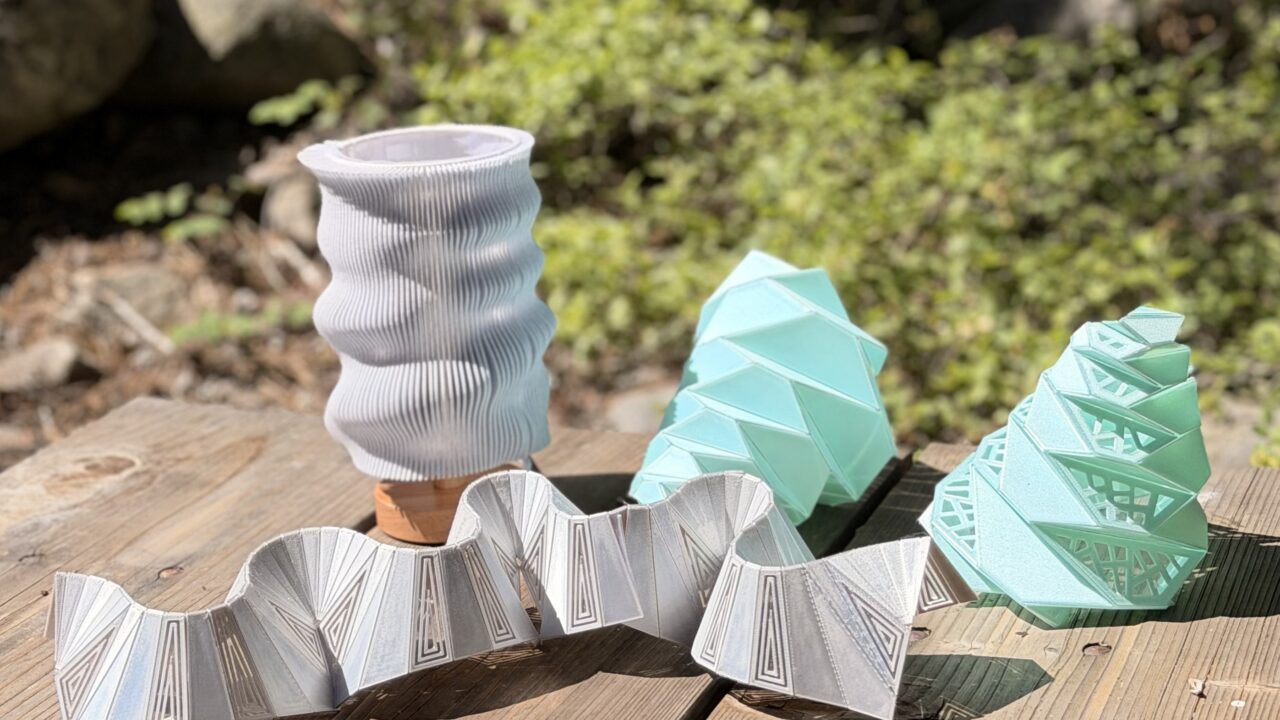
Design extends far beyond the visual; it is a continuous, physical dialogue that engages the entire sensory spectrum. By fusing rigid computational geometries with flexible textiles, Tactile Continuum moves beyond static sculpture to form a continuous flow of movement—active, breathing objects that provoke thought and emotion, ranging from comfort to curiosity.
Over the past two months of testing fabric 3D printing to achieve 4D kinetic behaviors, the core focus has been translating digital logic into physical behavior. As tension and geometry interact across this textile surface, the material begins to self-articulate. The static prints transform into responsive structures that shift with light and adapt under touch. Through the interplay of structural tension, motion, the raw acoustic sound of the material, and the deliberate choreography of light, these forms do not just occupy space. They shape the psychological and atmospheric pulse of an environment, translating material behavior into a deeply felt, tactile language.
Experimental Trials
This project serves as a living archive of this ongoing research. In the series below, each case study breaks down a specific material trial, documenting the computational parameters, the physical fabrication process, and the resulting atmospheric effects.
Rigid Meets Fluid
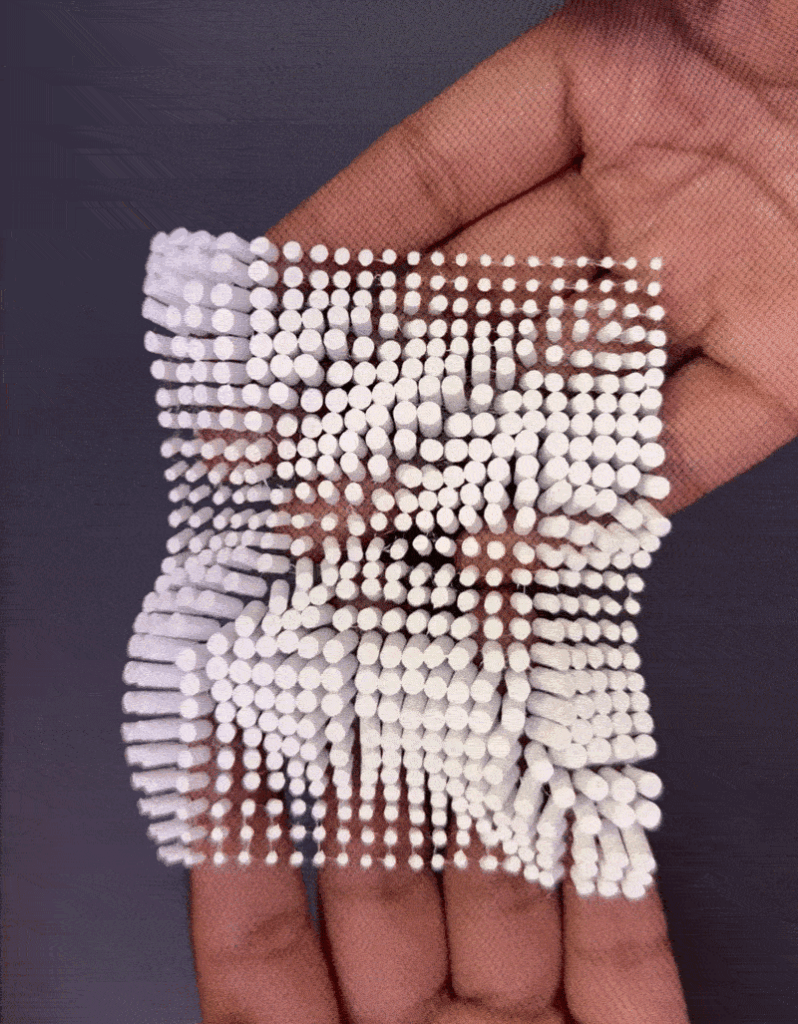
Exploring the adaptability of solid forms on a textile interlay, this early trial tests how variations in geometric density influence material movement. The structural pattern was developed in Grasshopper using a multiple attractor system and depth scaling to dynamically vary the thickness of the rigid 3D printed segments across the fabric, this experiment demonstrates how scaling the solid blocks and their surrounding kinetic gaps creates a highly fluid and adaptable material skin.
From Experiment to Object
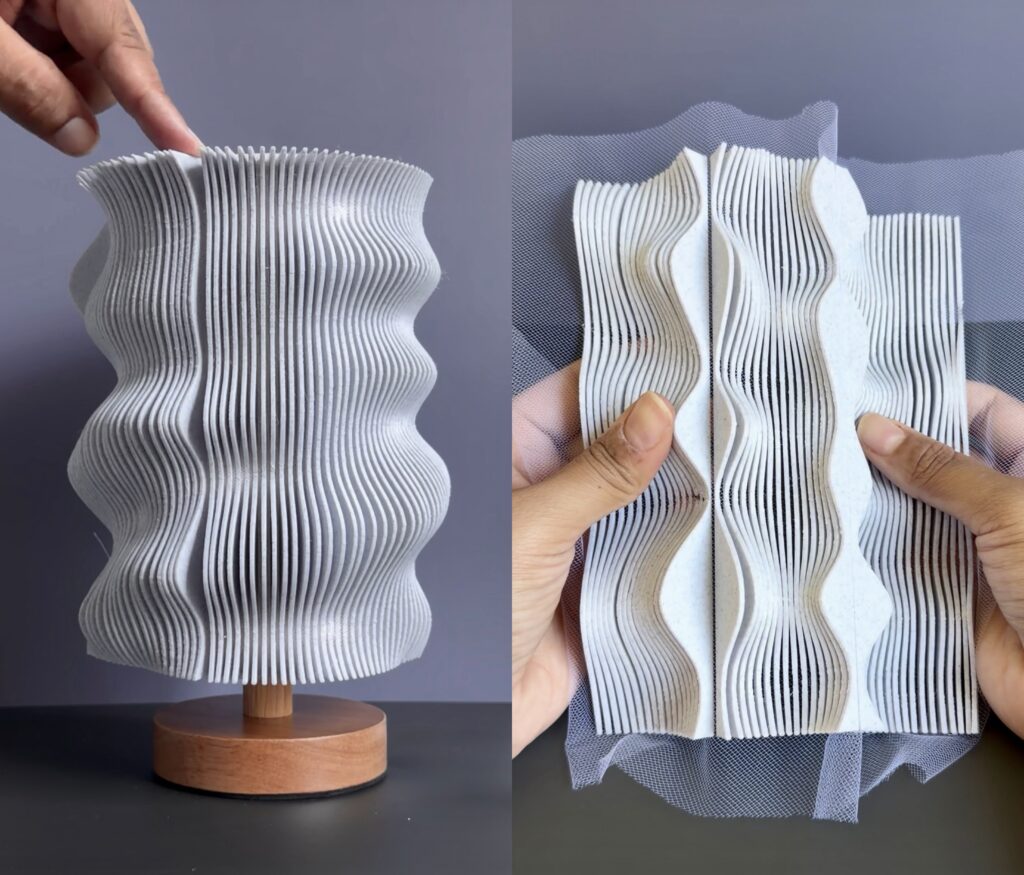
Pushing the fabrication research beyond initial material testing, this trial translates the 3D printing process into a functional object: a responsive lamp. By combining the structural integrity of the rigid printed blocks with the tension of the fabric interlay, the material articulates into fluid, undulating waves. This iteration demonstrates how the engineered gaps between solid segments allow a flat-printed pattern to be sculpted and adapted into diverse, three-dimensional forms.
Fragmented Light Sculpture — ‘Nova’
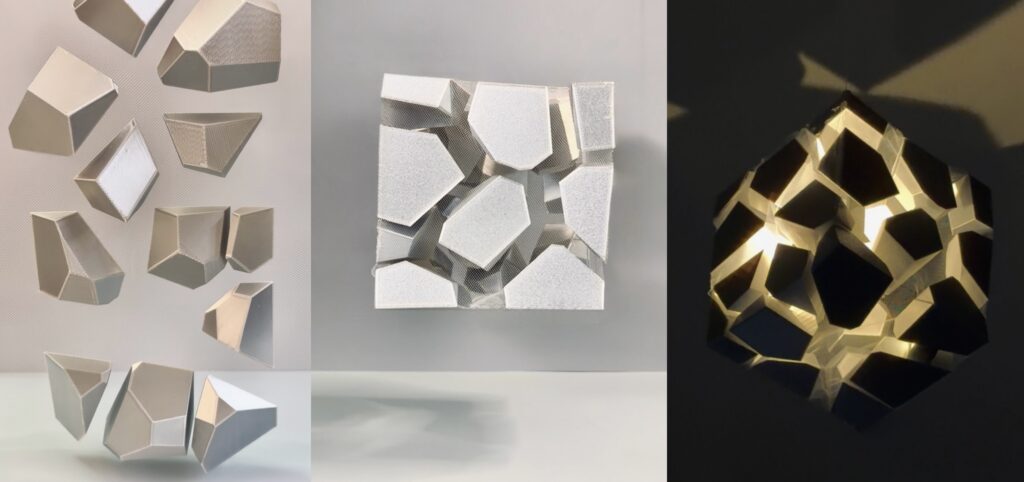
Inspired by a stellar explosion shedding its outer layers in a sudden burst of energy, Nova captures the moment of structural tension frozen in space. The computational form was generated in Grasshopper using Voronoi logic to create fragmented, solid geometries that simulate an old shell breaking apart. Through fabric 3D printing, an embedded mesh interlay suspends these rigid, floating pieces while allowing focused light to bleed through the engineered gaps between them. Translating digital algorithms into physical behavior, the piece balances structural tension with raw illumination, transforming a shattered pattern into a luminous sculptural form.
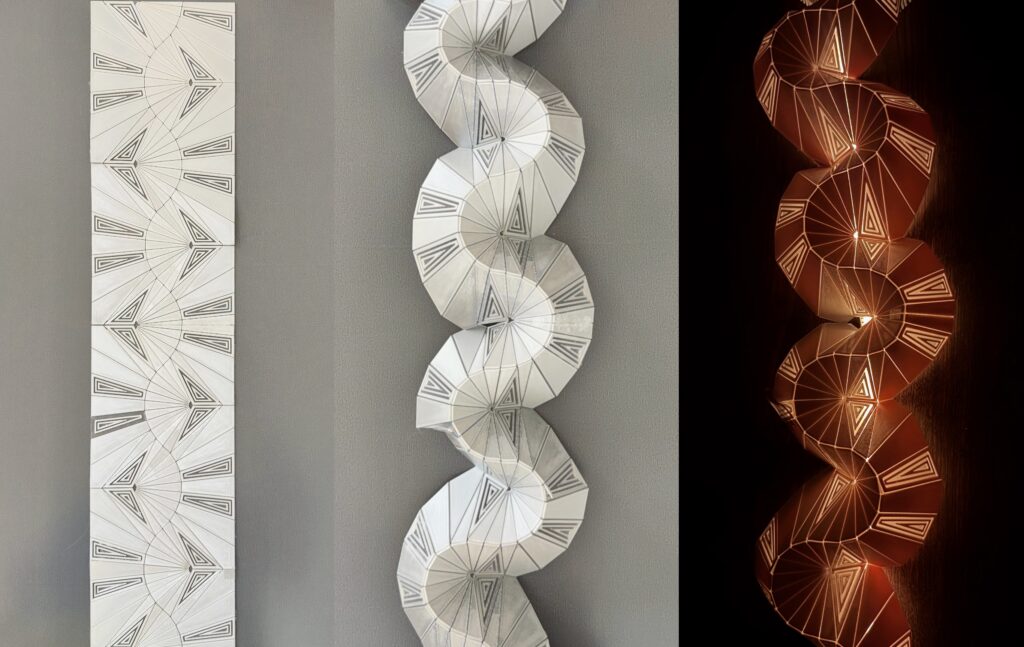
Sculpting Movement // Digital Origami
Focusing on the mechanics of motion, this trial introduces self-folding behavior into a dynamic light sculpture. By computing and depositing rigid geometric panels directly onto a fabric mesh, the unprinted textile spaces function as living hinges across the surface. What begins as a flat two-dimensional print effortlessly coils and articulates into a complex, spiral origami form driven entirely by the geometric constraints of the solid pieces. Backlit to accentuate its layered depth, the piece demonstrates how parametric folding logic can guide a flat sheet into a self-supporting, volumetric light structure.
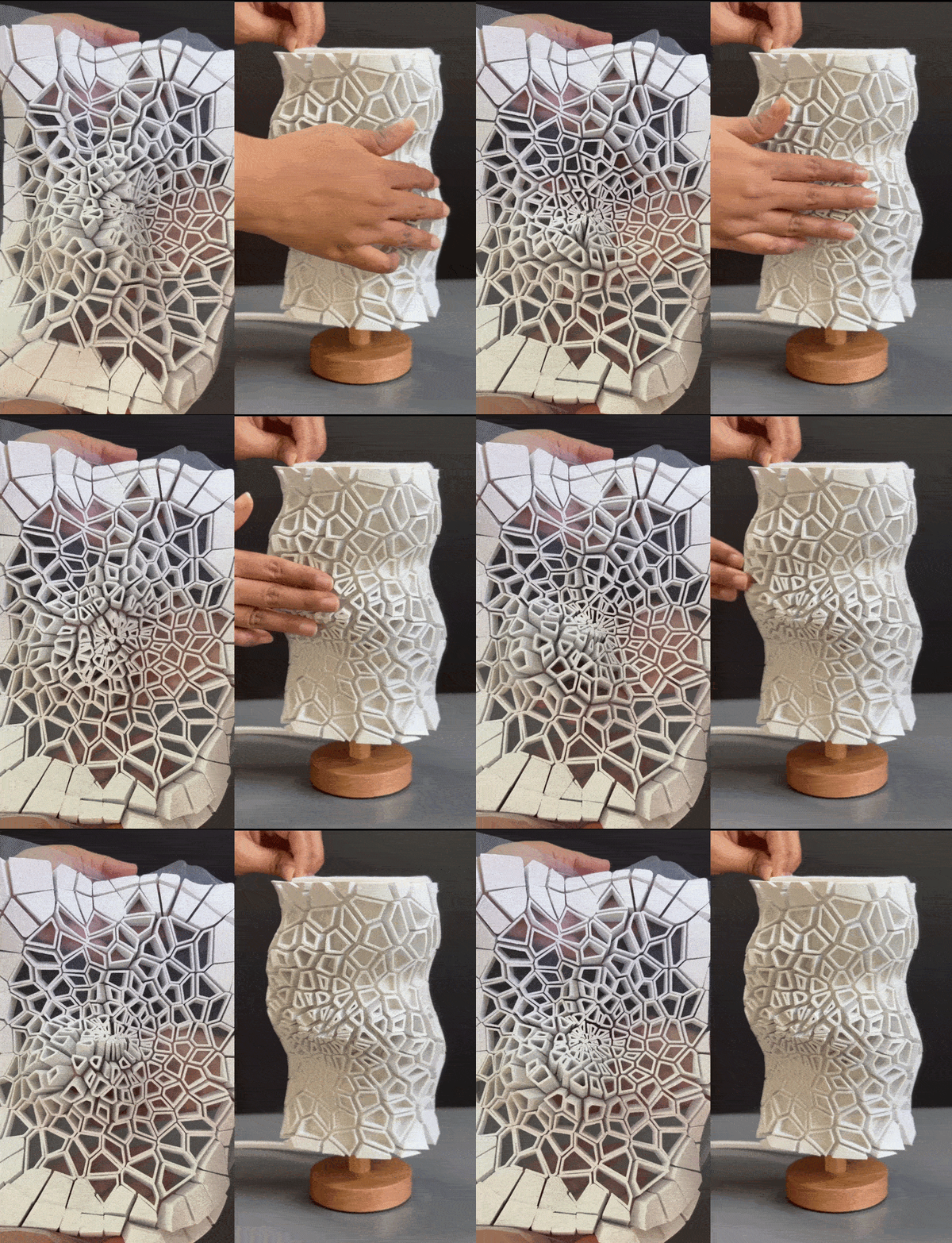
Nature’s Blueprint // Fibonacci Sequence
Exploring the Fibonacci sequence and the mathematical beauty of organic growth, this design is inspired by the natural, spiraling arrangement of leaves and seeds. Built in Grasshopper using a combination of spiral logic and mathematical expressions, the pattern creates a continuous, flowing form.
The core spiral expression is driven by:
X = cos (t) * t
Y = sin (t) * t
Using fabric 3D printing, rigid geometric segments are printed directly onto a textile interlay. The kinetic gaps between these solid blocks allow the flat-printed mathematical pattern to flex, wrap, and lock into a glowing lamp sculpture. It is flat-printed math, brought to life.
This research is ongoing. New computational trials and fabrication prototypes are continuously added as the series evolves.